Week Daze
Philosophy
Monday through Sunday, mercilessly ranked
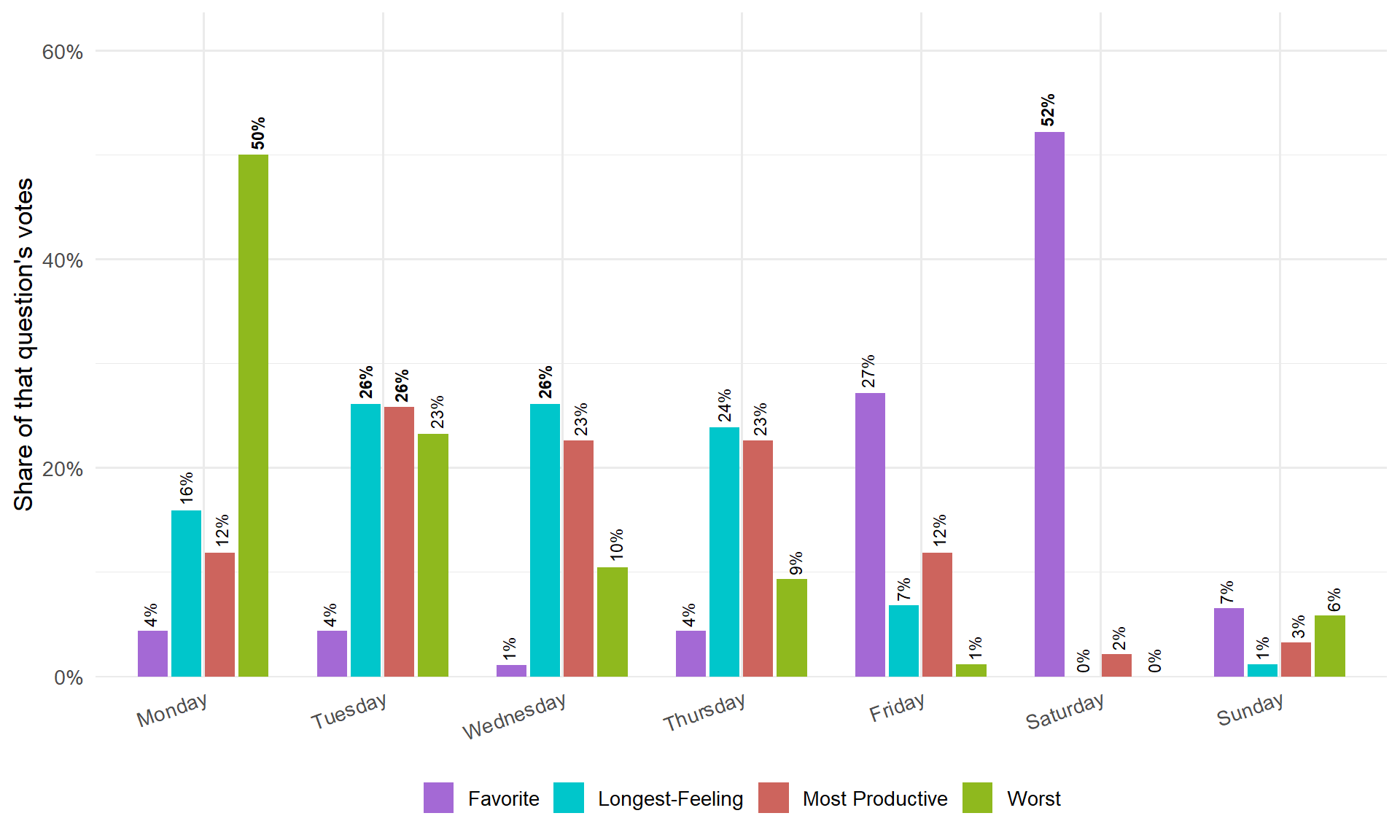
In honor of Labor Day, we asked you how you feel about your labored days.
How decisive were these results?
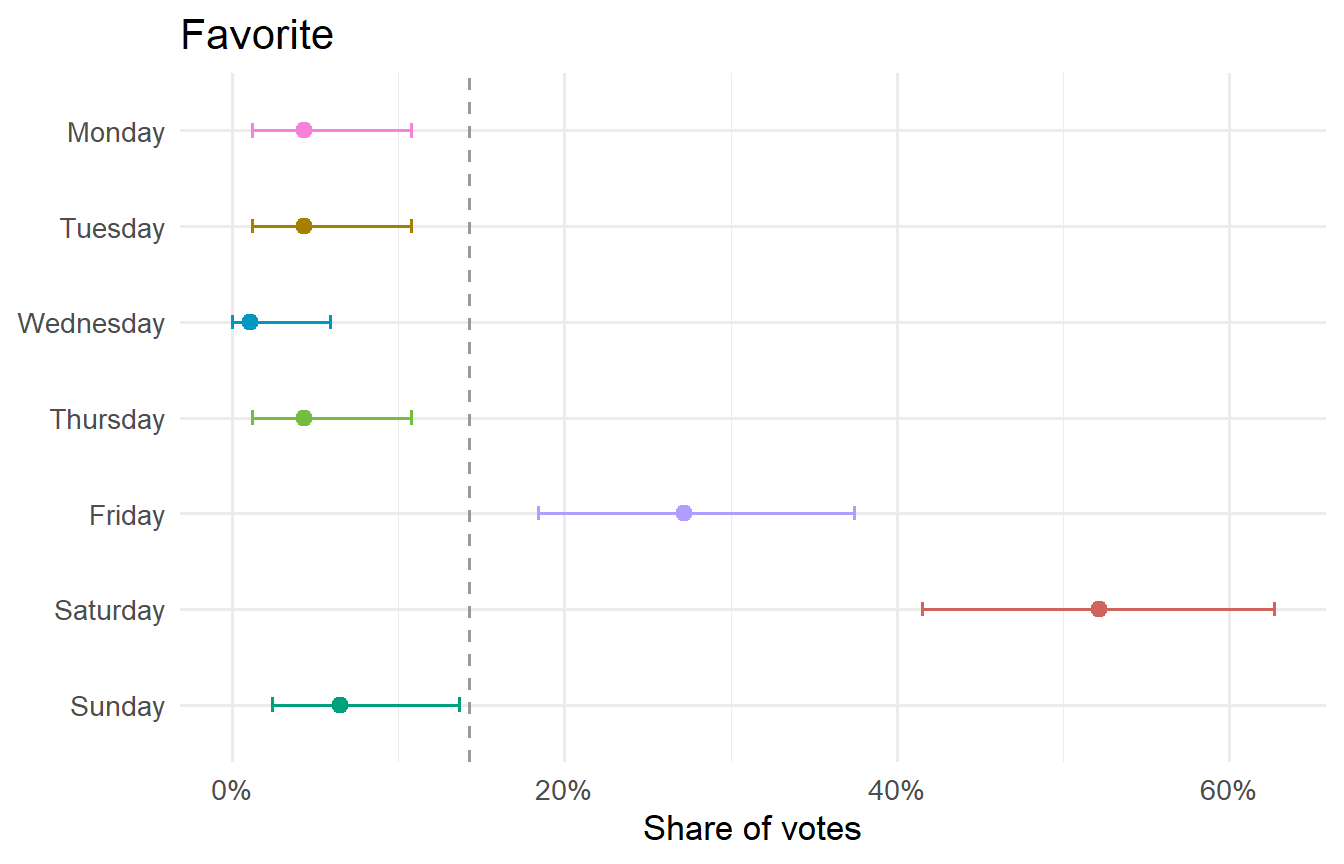
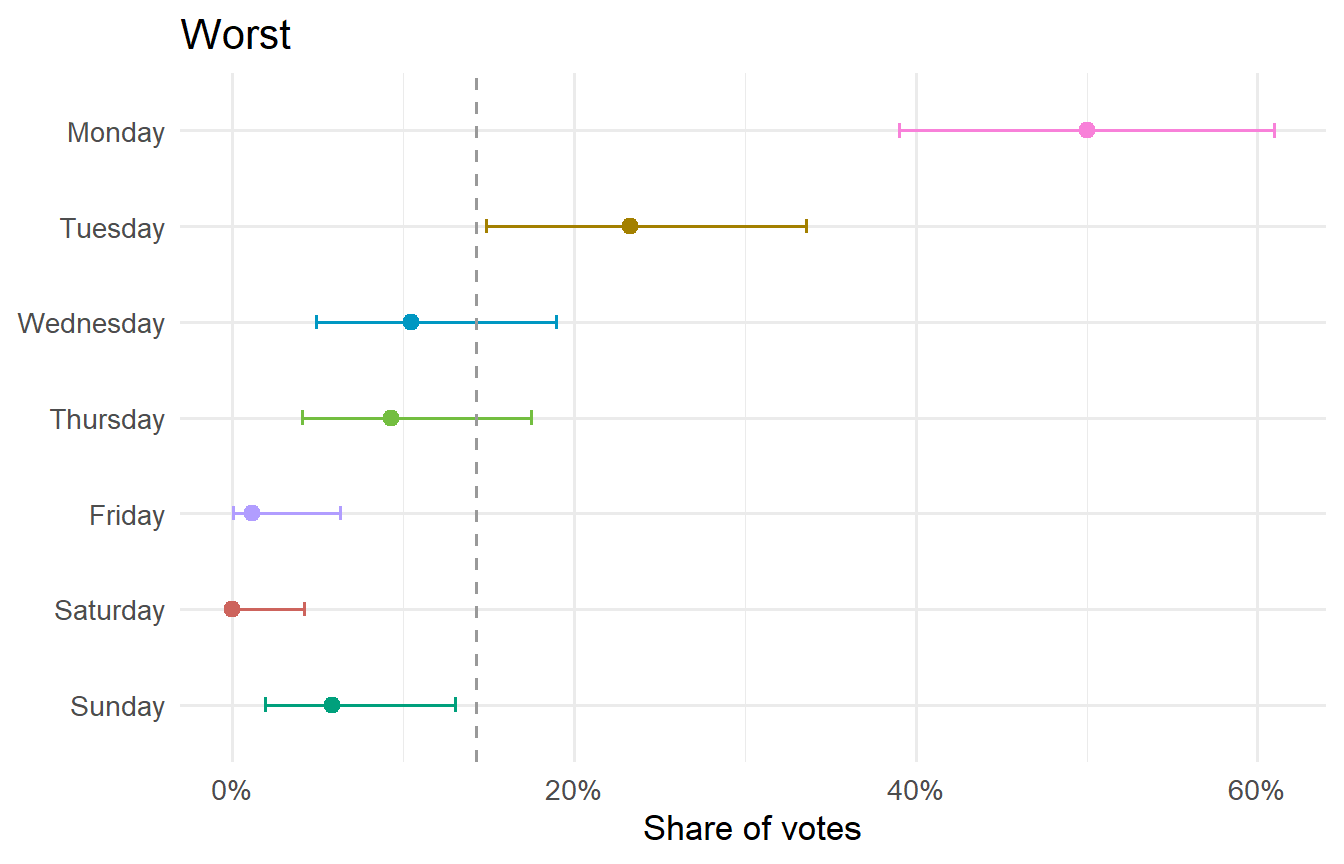
Four questions this week, and for the first time every single one offered all seven days of the week as an option instead of a simple either-or. That changes the math a bit: “is the split different from 50/50” doesn’t apply anymore, so instead we’re asking “is the split different from everyone-equally-likely” (1-in-7, about 14.3% each) using a chi-square goodness-of-fit test.
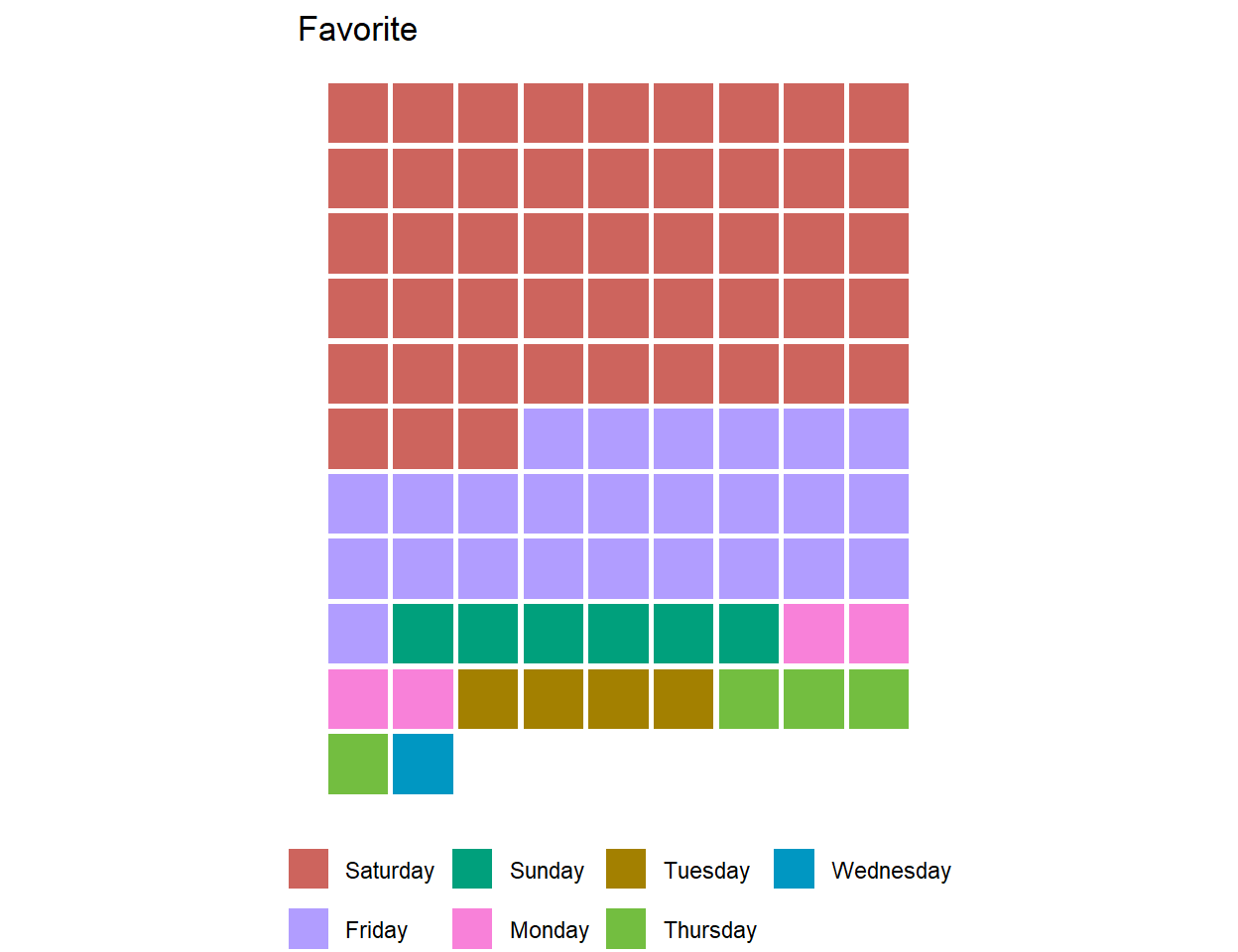
TL;DR: Favorite produced the most lopsided result of the week — Saturday alone took 52% of the vote, nowhere close to the 1-in-7 share you’d expect if people picked days at random. Most Productive was the closest thing to a genuine debate: Tuesday led with just 25.8%, the smallest winning share of the week — and only barely, just 0.3 points under Longest-Feeling’s 26.1%. And keep an eye on Tuesday — it wins Most Productive outright, and it doesn’t even have sole ownership of Longest-Feeling: that one’s a dead-even tie (Tuesday & Wednesday, 26% each). Tuesday is apparently both the most productive day of the week and, in a tie, one of the two that drags on forever.
| question | N | # options | Top pick (votes) | Top share | Zero-vote options | Chi-sq (df) | p vs uniform | p: top vs chance |
|---|---|---|---|---|---|---|---|---|
| Favorite | 92 | 7 | Saturday (48) | 52.2% | 0 | 137.3 (6) | 0.0e+00 | 0.00000 |
| Longest-Feeling | 88 | 7 | Tuesday & Wednesday (23) | 26.1% | 1 | 49.8 (6) | 0.0e+00 | 0.00331 |
| Most Productive | 93 | 7 | Tuesday (24) | 25.8% | 0 | 35.9 (6) | 2.8e-06 | 0.00423 |
| Worst | 86 | 7 | Monday (43) | 50.0% | 1 | 111.0 (6) | 0.0e+00 | 0.00000 |
Does HQ agree with RTP?
With seven options per question instead of two, “does HQ agree with RTP” isn’t a single leader’s-share comparison anymore either — it’s a chi-square test of independence on the full office-by-day table for each question. (Two Saturday cells got zero votes from both offices, in “Worst” and “Longest-Feeling”; those get dropped before the test, since an empty category has nothing to compare and would otherwise divide by zero.)
| question | Options tested | Options dropped (0 votes both offices) | Chi-sq (df) | p-value |
|---|---|---|---|---|
| Favorite | 7 | 0 | 11.3 (6) | 0.0803 |
| Longest-Feeling | 6 | 1 | 11.1 (5) | 0.0497 |
| Most Productive | 7 | 0 | 11.4 (6) | 0.0759 |
| Worst | 6 | 1 | 8.1 (5) | 0.1490 |
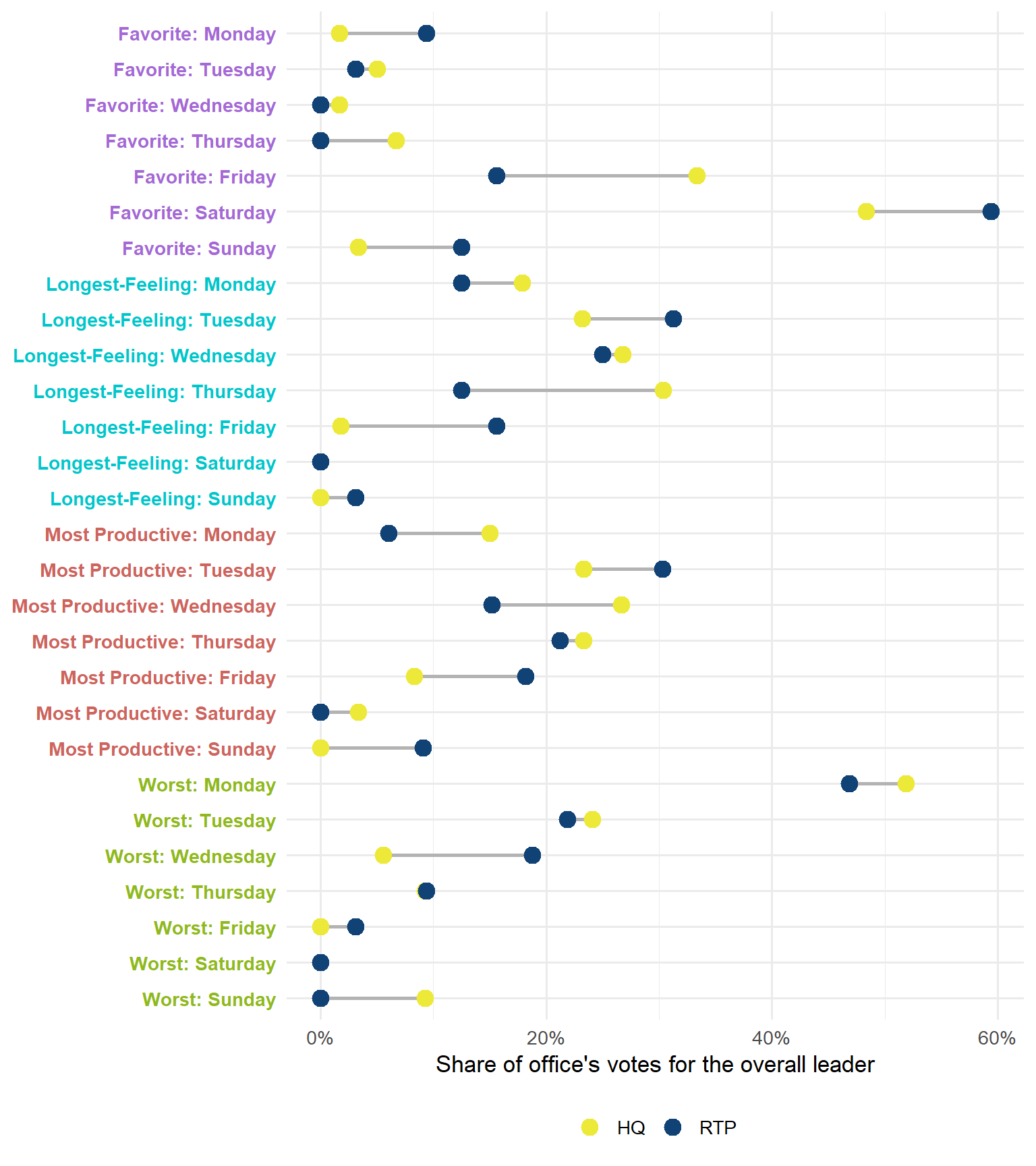
Longest-Feeling actually clears the usual p < 0.05 bar for a whole-distribution office difference — barely, at p = 0.0497. That’s a different kind of test than the leader-vs-leader comparison used on two-option polls, so it doesn’t add to that running tally of significant gaps, but it’s worth noting: it’s the same question where HQ and RTP picked entirely different winners.
Two of the four questions did flip the top pick between offices this time: for Longest-Feeling, HQ’s pick was Thursday while RTP’s was Tuesday; for Most Productive, HQ went with Wednesday while RTP went with Tuesday. The other two questions (Favorite and Worst — the two most lopsided results of the week) had both offices landing on the same day. That brings the running flip tally to 11.
The Alignment Index for this poll alone comes out to 0.83, and the cumulative index actually ticks up slightly to 0.89 — despite two flipped top picks, the overall pattern of support across all 28 day-options tracked reasonably well between offices. Flipping a close plurality race is a lot easier than derailing a correlation across dozens of data points.
Do the weekday blues run deep?
Saturday swept “Favorite” and Monday swept “Worst” — the most classic possible result for a work-week poll. Let’s bound how much those two crowds overlap.
Of the 86 overlapping voters, the “Saturday-loving, Monday-hating” crowd could be as small as 0 or as large as 43 people (0%–50%), versus about 22 (26%) expected if the two opinions were unrelated. Unlike some past overlaps, the floor here genuinely can be zero — with two majorities this large but not landslide-enough to force an overlap by the pigeonhole alone, the totals alone can’t rule out two completely disjoint crowds, even though basic intuition says the Saturday fans and the Monday haters are probably the same people.